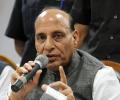
The two terrorists who attacked a Border Security Force convoy on the Jammu-Srinagar Highway, killing two jawans, belong to Pakistan, the government said in Rajya Sabha on Thursday.

The Border Security Force (BSF) destroyed five Pakistani posts and a terrorist launch pad across the Jammu border in an operation, an officer said. The BSF retaliated after Pakistan targeted civilian areas and Indian establishments in a systematic manner, the officer said.
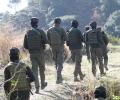
Security forces on Saturday extended the ongoing search operation to new areas after the body of the fourth policeman and two slain terrorists were recovered from the scene of a gunfight in a remote forested area in Kathua district of Jammu and Kashmir, officials said.

In a stern warning to Pakistan, Army chief General Upendra Dwivedi said on Friday that the neighbouring country should stop sponsoring terrorism on its soil if wants to retain its place on the world map.
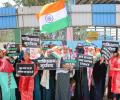
The Indian government has blocked 16 Pakistani YouTube channels for allegedly disseminating provocative and communally sensitive content as well as false and misleading narratives against India, its Army and security agencies. The decision was taken following recommendations from the Ministry of Home Affairs in the wake of the April 22 terror attack at Jammu and Kashmir's Pahalgam in which 26 people, mostly tourists, were killed.
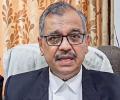
Noted lawyer Ujjwal Nikam, who is among four persons nominated to Rajya Sabha by President Droupadi Murmu, on Sunday said Prime Minister Narendra Modi called him to inform and spoke in Marathi.
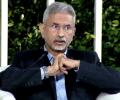
On President Putin's two-day trip to India, Jaishankar said for a "big" and "rising" country like India, it is important to maintain good cooperation with as many important players as possible in the world in line with freedom of choice.

The encounter between security forces and terrorists in the Gudar forest area of Kulgam, Jammu and Kashmir, has entered its second day. Two terrorists and two soldiers have been killed in the ongoing gunbattle.

The National Investigation Agency (NIA) has started interviewing eyewitnesses, including tourists, in connection with the deadly terrorist attack in Pahalgam, south Kashmir. The attack, carried out by terrorists from the Pakistan-based Lashkar-e-Taiba (LeT), claimed the lives of 26 people on April 22. Initial investigations suggest that five to seven terrorists were involved, aided by local militants trained in Pakistan. Security forces are conducting massive operations to hunt down the terrorists in the dense jungles of the Pir Panjal range.
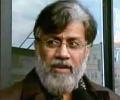
A Delhi court has sought the trial records of the 26/11 terror attack from a Mumbai court ahead of the expected extradition of the crime's alleged mastermind Tahawwur Hussain Rana to India from the US. The US Supreme Court has cleared the way for Rana's extradition, dismissing his final legal challenge against the move.
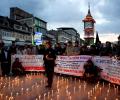
'A terrorist has no religion -- they are nothing but the face of evil. When you offer namaz for a terrorist, attend their funeral, or give them a grave, you affirm that they belong to a religion. That must stop'
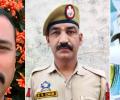
Balwinder Singh Chib, a police officer in Jammu and Kashmir's Kathua district, was killed in an encounter with Pakistani terrorists, continuing a legacy of sacrifice that spans three generations of his family. Chib's great-grandfather and uncle were also martyred in the line of duty, and his brother died during World War I. The family is venerated in their village for their history of patriotism and sacrifice.

New Delhi might have loudly welcomed an age of multipolarity, hedging and strategic autonomy. But it seems the winner in that game is Islamabad, not us, points out Mihir S Sharma.
'India has experienced any number of doctors, engineers, and individuals from professional backgrounds being implicated in terrorism. This is not a novel development.' 'These are mobilisations of opportunity. One does not exclusively associate with one's own kind. A comprehensive conspiracy requires diverse skill sets.' 'One needs individuals with local community contacts, those possessing physical capabilities, technical expertise -- an entire spectrum of capacities.'

The United States has slapped sanctions on three Pakistan-based "terrorist facilitators" for helping the Taliban and other militant groups in Pakistan, Afghanistan and Uzbekistan, including one man linked to a failed car bomb attack in New York in 2010.

Union Home Minister Amit Shah on Friday said the victory of the Bharatiya Janata Party-led National Democratic Alliance in the Bihar polls was a mandate against infiltrators in the country because citizens will never favour those parties that support such illegal immigrants.

A policeman was also injured in the gunfight that broke out in Bajaad village in the Gandoh area around 9:50 am.
Defence Minister Rajnath Singh told an all-party meeting that at least 100 terrorists were killed in the Indian strikes on terror sites in Pakistan and Pakistan-occupied Kashmir under 'Operation Sindoor'. Leaders from various parties showed maturity and extended all support to the government and armed forces.
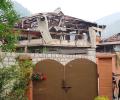
Markaz Taiba of Lashkar-e-Taiba (LeT) in Pakistan's Muridke, one of the nine terror camps struck by the Indian armed forces on Wednesday, is a site where terrorists including Ajmal Kasab involved in the 2008 Mumbai attack were trained, a senior military official said.

The Jammu and Kashmir Police has unearthed an interstate and transnational terror module of Jaish-e-Mohamamd and Ansar Ghazwat-ul-Hind outfits by arresting seven persons, including two doctors, and recovering arms and ammunition, officials said in Srinagar on Monday.

The empty cartridges found at Pahalgam and those after test firing by the recovered guns were matched by the forensic lab, Shah said. The ballistic report is with him, he added.
The terrorists chose Baisaran as the target due to its "high tourist presence", "relative isolation" and after considering that the "response (from the security agencies) would take time".

"In 1948, Indian armed forces were in a decisive position to take back Pakistan-occupied Kashmir but then PM Jawaharlal Nehru declared unilateral ceasefire," Amit Shah said. In 1971, Shah said, 93,000 Pakistani soldiers surrendered and India had 15,000 sq km Pakistan territory under control, but still PoK was not taken back. During the 1962 war with China, then PM Nehru bade goodbye to Assam in a speech on Akashvani, he said.
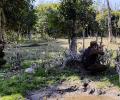
An Army Junior Commissioned Officer (JCO) was killed in an encounter with terrorists along the Line of Control (LoC) in the Akhnoor sector of Jammu and Kashmir. The terrorists' infiltration attempt was thwarted, but the JCO succumbed to injuries sustained during the encounter. This incident comes after a recent brigade commander-level flag meeting between India and Pakistan to discuss border management, highlighting the ongoing security challenges in the region.
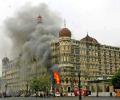
Tahawwur Rana, accused of involvement in the 2008 Mumbai terror attacks, is expected to be extradited to India from the United States soon. The US Supreme Court denied his last-ditch effort to stop his extradition, moving him closer to being handed over to Indian authorities. Rana's extradition is expected to help probe agencies expose the role of Pakistani state actors behind the attacks and shed new light on the investigation. He is associated with Pakistani-American terrorist David Coleman Headley, one of the main conspirators of the 26/11 attacks.

In his address, Jaishankar warned that those who condone nations that sponsor terror will find that it "comes back to bite them".
In response to a question on President Donald Trump offering to "mediate" on the issue of Kashmir, Bruce said, "Well, I - obviously, I can't speak to what's on the mind or the plans of the President. What I do know is that I think we all recognise that President Trump in each step that he takes, it's made to solve generational differences between countries, generational war."
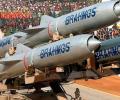
The Navy would be using the missiles for equipping its Veer-class warships while the Indian Air Force would be using them to equip its Russian-origin Su-30 MKI fighter jet fleet, the sources said.
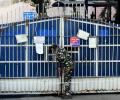
Tahawwur Hussain Rana, a Pakistani-born Canadian national accused in the 2008 Mumbai terror attacks, is likely to be lodged in a high-security ward in Tihar jail upon his extradition from the US. Rana, a close associate of David Coleman Headley, a US citizen who was also involved in the attacks, will be brought to India after his last-ditch attempt to evade extradition was rejected by the US Supreme Court. The attacks, which lasted nearly 60 hours, resulted in the deaths of 166 people and sent shockwaves across the country.
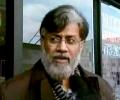
A multi-agency team has gone to the US and all paperwork and legal issues are being completed with US authorities to bring him to India, they said.

Vinubhai Dabhi and his wife Lilaben, residents of Bhavnagar, Gujarat, recounted their harrowing experience during the Pahalgam terror attack in Kashmir. Dabhi was injured by bullets while his wife witnessed the shooting of a young man, Smit Parmar. They both highlight the lack of security presence during the incident.
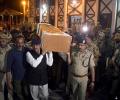
Late Jammu and Kashmir Police deputy superintendent Humayun Bhat, who died in a 2023 encounter with terrorists, was posthumously awarded the President's Police Medal for Gallantry for his courageous actions during a 2021 gunfight. Bhat was earlier honored with the Kirti Chakra, the nation's second-highest peacetime gallantry award, for his role in neutralizing a top local commander of the banned Lashkar-e-Taiba (LeT) and a Pakistani terrorist.
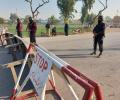
No group or individual claimed responsibility for the attack, but such strikes are usually carried out by the Tehreek-e-Taliban Pakistani (TTP).
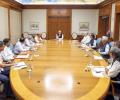
Terrorism and insurgency in J&K had subsided when India demolished East Pakistan -- for the simple reason that Pakistan understands power. We need to follow Chanakya's dictum of Saam, Daam, Dand, Bhed for strategising against Pakistan, asserts Lieutenant General Prakash Katoch (Retd). The ground truth is that unless we are prepared to acknowledge our shortcomings, including massive intelligence failures, punish those responsible and take corrective actions, we will continue in the same vein, asserts Lieutenant General Prakash Katoch (Retd).
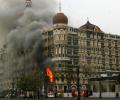
Tahawwur Rana has the answers to festering questions on the 26/11 terror attacks and the NIA must pry it out of him, even if they have to feed him biryani, advocates Athimuthu Ganesh Nadar.
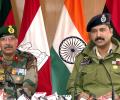
Officials have also written to the Pakistan side regarding the medicines, an official statement said.

Over 100 terrorists, including high-value targets such as Yusuf Azhar, Abdul Malik Rauf and Mudasir Ahmed, were eliminated during Operation Sindoor on May 7, the Indian military said on Sunday.
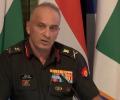
The Pakistan Army has accused India of attempting to manipulate history by creating fabricated narratives, following claims by the Indian Army regarding Pakistani casualties along the Line of Control.
Tahawwur Hussain Rana, a Pakistan-born Canadian national and close associate of David Coleman Headley, could be extradited to India in connection with the 26/11 Mumbai terror attacks. Rana's travel history in parts of north and south India before the attacks in 2008 is expected to provide crucial leads for the investigation. His extradition would mark the third person to be tried in India for the attacks, after Ajmal Kasab and Zabiuddin Ansari alias Abu Jundal.
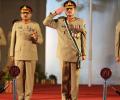
India has issued a strong warning to Pakistan against continuing its 'hateful' rhetoric and any potential misadventures, following recent nuclear threats and remarks from Pakistani leadership.
